
Basic Macro Markets (Part 2): What is a Bust?
Dave and Claude Explain Economics, Week 9

This week’s is delayed, again, because Claude had a hard time figuring this one out, again. I’m taking this as “job security!”
Alright, so last week we talked about booms. Basically, a boom a period where an economy is producing more than it can in a “sustainable” way. By “sustainable,” I don’t mean what the environmental people mean (though that may be a part of it), I mean more along the lines of “given how many workers there are, how much capital there actually is, and the state of technology, we are producing beyond our Long Run capability as indicated by the Long Run Aggregate Supply.”
This naturally leads to a question of “well what’s a bust, then?” And at some level, the question is pretty easy: it’s the exact opposite of a boom: the economy is producing less than its long run potential.
In a bust, the Short Run Equilibrium (where the SRAS and AD curves cross) is to the left of the Long Run Aggregate Supply curve. It’s useful to point out here, which I probably should have done last week, that the economy is always wherever these two lines (SRAS and AD) cross. Sometimes, those lines cross at a point on the Long Run Aggregate Supply, in which case we are in neither a boom nor a bust. But most of the time, we’re in one or the other.
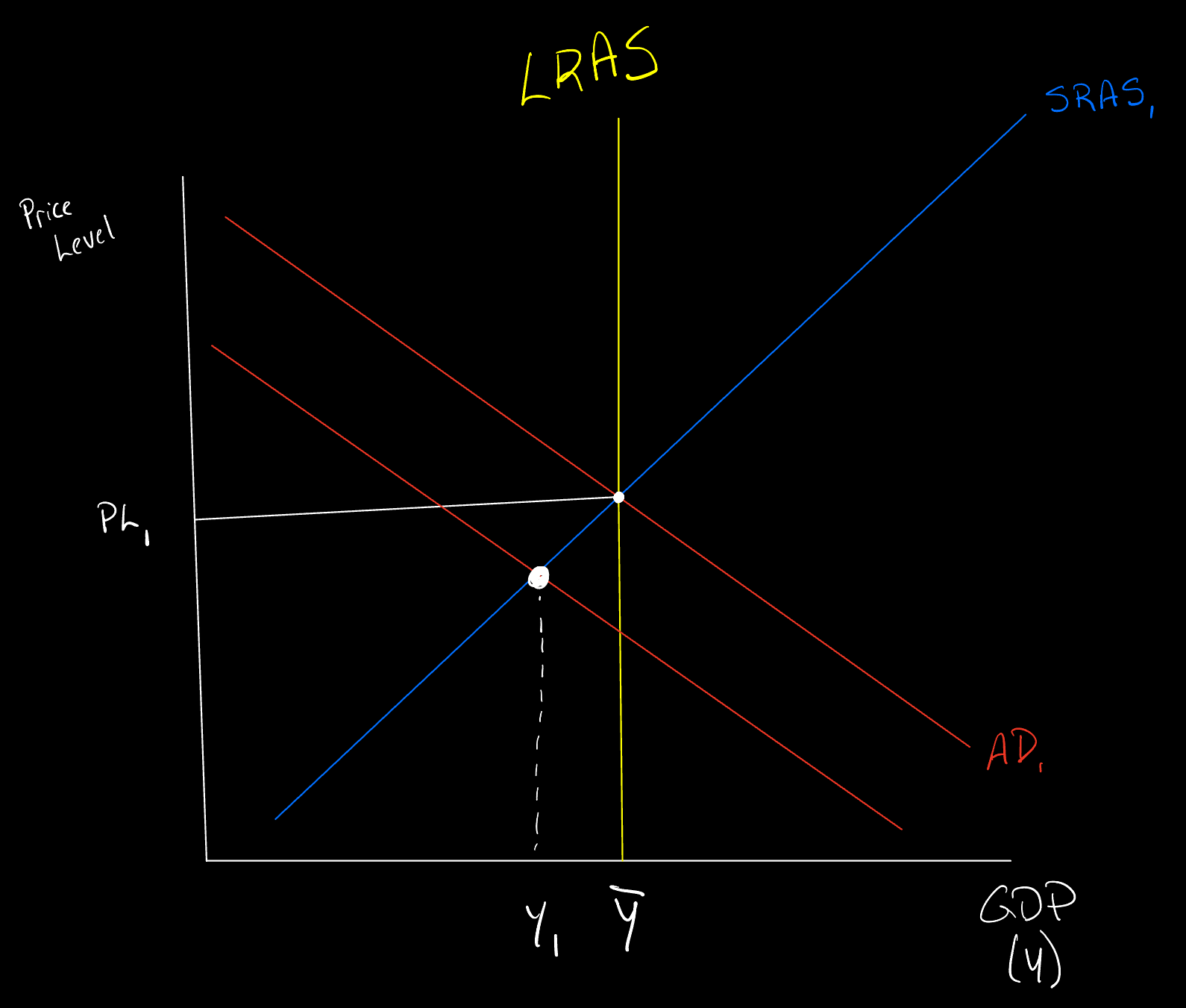
When the economy is in a bust, we can infer a few things. First, unemployment will almost certainly be rising because firms are producing less output than they would otherwise be producing. Why do firms lay off workers in a bust? Well, it’s pretty hard to lay off capital equipment and recover much of anything. But if you lay off workers, you save money on your wage bill!
Second, we can infer something about what’s likely to happen to prices: most of them are going to start coming down (or, more accurately: rising more slowly). Remember what we said about “sticky prices” last week: the idea that some prices, such as wages and raw material prices, are slower to change than others, such as the price of final goods like gasoline. In a bust, we can see by looking over at the Y-axis, that the overall price level has fallen. This typically means that prices for consumer goods are falling (or not rising as quickly). While politicians typically say that they want prices to come down, most are pretty reluctant to see that actually happen.
So here’s the question we need to ask: if we’re in a bust, how do we get out of it? There are two pathways:
Boost Aggregate Demand
The first way we’ll go over is probably the most straight-forward: all we need to do is boost aggregate demand. Here, we can use the tremendous purchasing power of the US government to act as a “buyer” in some sense and have them spend tremendous amounts of money, so much so that they actually lead to an increase in the overall Aggregate Demand of the US. This isn’t hard to imagine. Washington DC has a budget of about $7 trillion while the US economy’s total GDP is $30 trillion. In other words, federal spending alone is about 23% of GDP. So yea… they can move the Aggregate Demand curve (and next week’s post will be about how).
Graphically, this would shift the AD line to the right and the economy would move from Point 1 (where there was a bust) to Point 2 where the bust is abated:
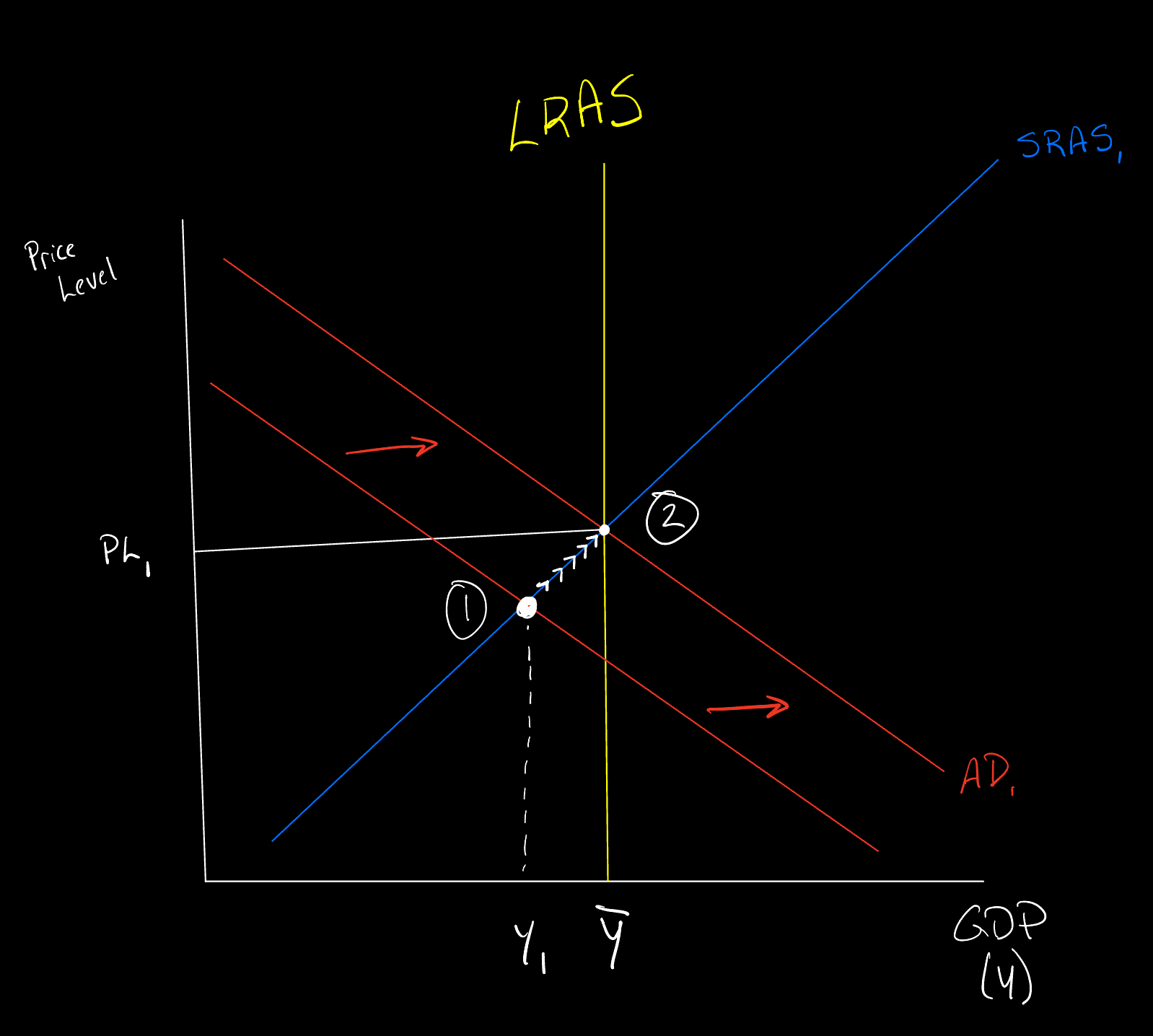
This sounds pretty straight-forward and, at least conceptually, it is. We’ll talk more about some complications on this next week. But for now, from a conceptual point of view, this isn’t hard to grasp or otherwise understand.
The Automatic Adjustment Mechanism
But if you stop and think about it, boosting Aggregate Demand isn’t the only way to get out of the bust (where the Short Run Equilibrium is left of LRAS). We could also move the SRAS curve to the right.
But how do we do that?
And herein lies the interesting insight. We do that… by doing nothing. Remember, some prices adjust more quickly than others. But if all prices adjusted the same amount, well there’s really be no difference in hardly anything. As a thought experiment: what if I waved a magic wand and doubled all the money in your bank account, wallet, salary, retirement accounts… etc? That would sound awesome! But what if waving that magic wand also doubled all the prices at all the stores, too? You have twice as many dollars but everything costs twice as many dollars. So are you wealthier than you were before? In terms of dollars (what economists call “nominal”), yes! But in terms of what you can do with those dollars (what economists call “real”), not at all. Importantly, though, you’re not poorer in real terms, either. Everything is exactly the same; it’s just that everything costs twice as many dollars but you also have twice as many dollars.
During a bust, final goods prices have fallen while other prices, such as wages, raw material prices, rent, etc. are all still locked in at their previously higher price. But as those contracts come up for renewal, they can be renegotiated downward. And as those prices fall, the cost of production falls back in line and the SRAS curve will shift to the right.
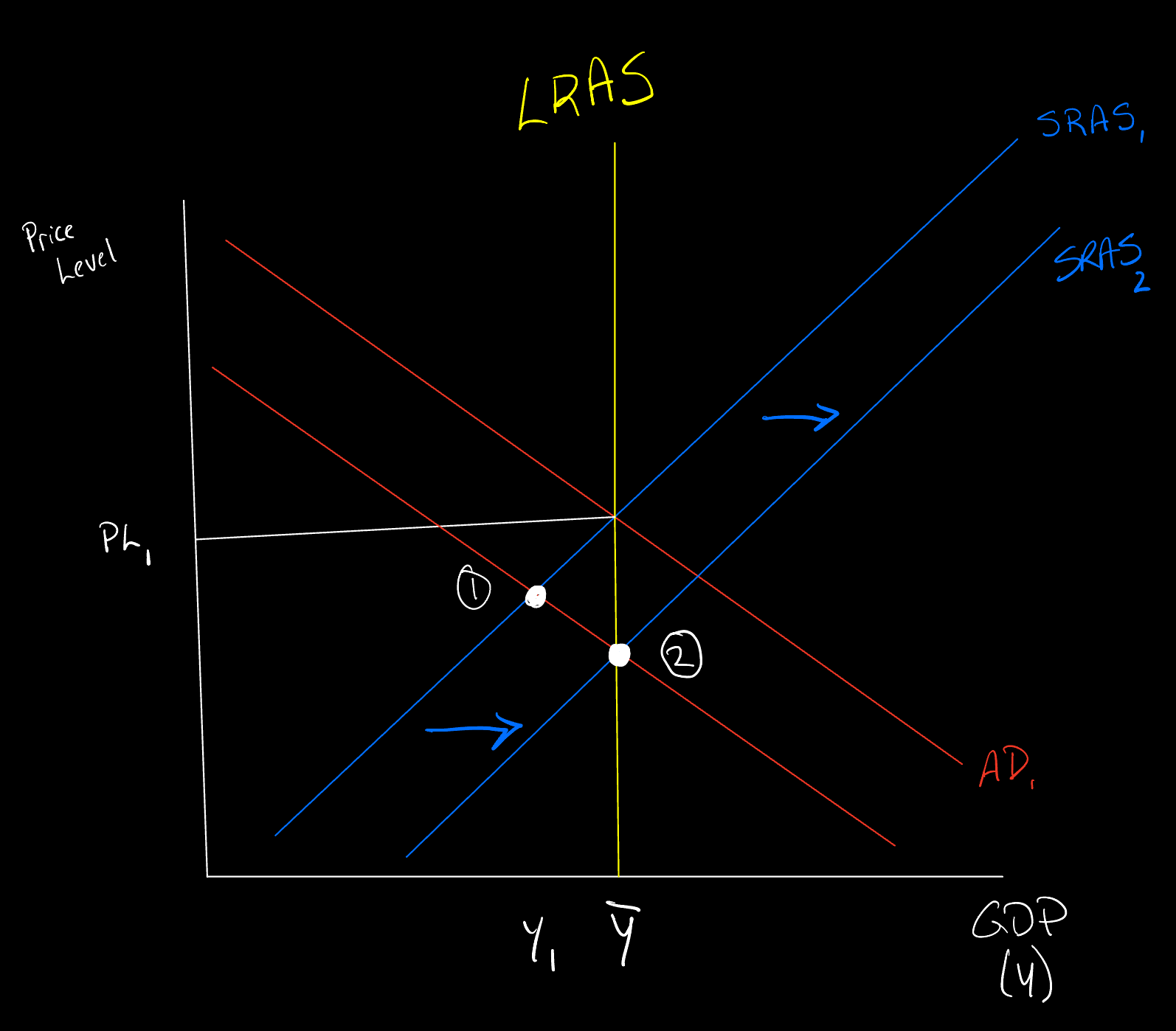
Through this, we get out of the bust and back to the Long Run Aggregate Supply curve and everything is hunky doory.
And this, too, isn’t difficult to understand. Prices adjust, markets clear, and we get out of a bust. Problem solved, no government required. Libertarians, eat your heart out.
But what’s the problem with this? Notice that it requires that workers accept lower wages (or, again, more accurately: smaller raises than they might have been used to). Explaining to people “hey, it’s alright that you make fewer dollars because the price of everything else went up more slowly, too!” doesn’t tend to cut it. People tend to have an emotional connection to their the number of dollars on their paycheck and how that number changes over time. If people expect it to go up by X% in a given year and instead get some number less than that, even if it all works out the same or even better in real terms, people still tend to get upset. I saw research at some point, but can’t seem to find it now, suggesting that people would rather get a 5% raise while prices rise 4% than get a 3% raise while prices stay the same. In the latter case, they’re actually wealthier in real terms, even though they got a smaller nominal raise. To an economist, this is intriguing. But to a person, this… kind of makes sense. We tie a lot of our self-identity (rightly or wrongly) to how many dollars we make. We want that number to go up fast because that means we’re worth more! Sort of.
Conceptually
Setting all that aside, we’re now faced with a question: if we find ourselves in a bust, should we try to get out of it by boosting Aggregate Demand or should we just let SRAS shift to the right and call it good?
One consideration (besides the psychological considerations above) is “how quickly will these two get us out of the bust?” If boosting AD will get us out of it by the end of the week but waiting for SRAS to shift will take a year, a pretty compelling case can be made for boosting AD as the appropriate means. Likewise, if SRAS is shifting quickly and everyone’s cool with it, then maybe we want to just let that happen instead.
There are other considerations to keep in mind, too. But those will have to wait for next week.