
Monetary Policy
Dave and Claude Explain Economics

Sorry for the delay in getting this one out. I fell off the pace last week, had a Classical Liberalism seminar to help facilitate, and, well, here we are. Also, Opus 5.0 on Claude is weird and I’m sticking to 4.8.
We’ll get back on the regular Monday-Wednesday schedule next week.
Ask someone whether they would like more money and you will get a look. Obviously they would. So it sounds strange to hear economists talk about the “demand for money” as if it were an open question. It is an open question, just not the one you would think. Nobody is asking whether you want to be wealthy. They are asking what form you want your wealth to take, and how much of it you want sitting around in spendable form.
That distinction turns out to be the hinge the entire Federal Reserve swings on. So it is worth a minute.
Say you come into $2,000. You can leave it in checking, where you can spend it this afternoon, or you can move it somewhere that pays you: a CD, a Treasury, a savings account with a real yield. Money that pays you cannot be spent at the hardware store on Saturday without some hassle first. So the choice comes down to what you are giving up by keeping it spendable.
And that depends entirely on what the other option pays. If a one-year CD pays half a percent, keeping your $2,000 liquid costs you ten dollars a year. Most people happily pay ten dollars for the convenience. If the CD pays six percent, the same convenience now costs $120, and suddenly the trip to the bank is worth making.
There is the whole idea. The interest rate is the price of keeping money in your pocket. When that price is high, people economize on pocket money and move it into things that earn. When it is low, they do not bother. High rates, less cash floating around. Low rates, more.
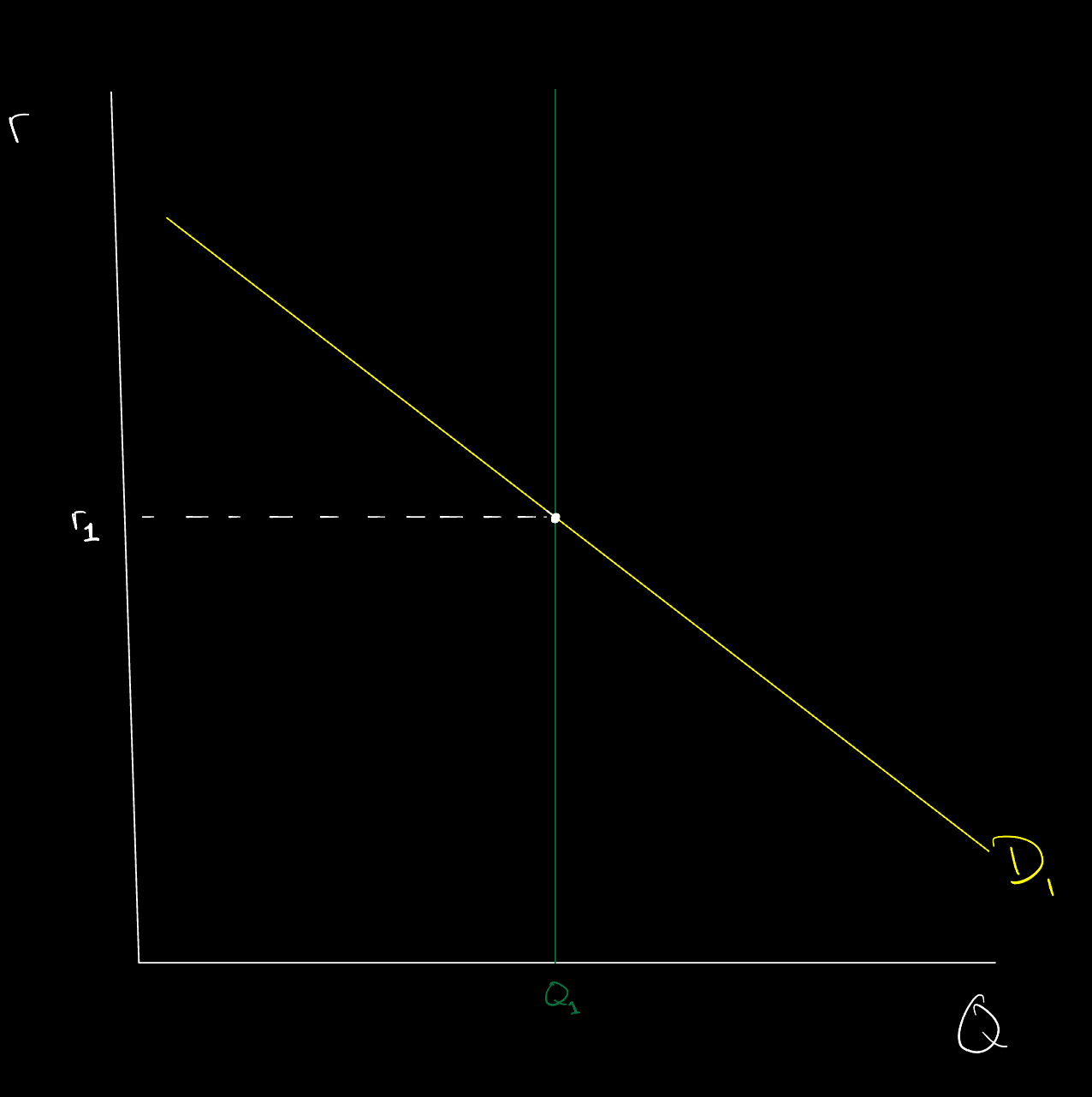
The Fed controls that vertical line. If they shift it to the right, the interest rate will fall. If they shift it to the left, the interest rate will rise.
Note for my monetary friends: yes, I know. You don’t have to get at me about it.
How the Fed moves the line
Your bank does not keep your deposits in a drawer with your name on it. It lends most of them out and keeps a fraction on hand. That is fractional reserve banking, and it is why the bank pays you interest instead of charging you for a safe deposit box.
It also means that if every depositor turned up on the same morning wanting cash, the bank could not pay. One bank in that spot can usually borrow from others. If every bank is in that spot at once, there is nobody left to borrow from, and you have a banking panic. Preventing exactly that is why Congress created the Fed in 1913, built out of twelve regional Reserve Banks, to act as the lender of last resort: the one institution that can always lend when no one else will.
That same plumbing gives the Fed three ways to change how many dollars are circulating.
The reserve requirement is the minimum share of deposits a bank must keep rather than lend. Raise it and banks lend less, shrinking the money supply; lower it and they lend more. This is the tool every textbook opens with, so it is worth knowing that the Fed set it to zero in 2020 and has left it there, which means the real work now runs through the other two, plus the interest the Fed pays banks on the reserves they hold.
The discount rate is what the Fed charges banks to borrow from it directly. Cheaper borrowing, more lending, more money. Costlier borrowing, less.
Open market operations are the workhorse. To put more dollars in circulation, the Fed buys bonds from banks and pays with newly created money. To pull dollars out, it sells bonds. This is, quite literally, how new money enters the economy.
Three tools, one purpose: sliding that vertical line left or right.
Lower rates and Aggregate Demand
Say the Fed buys bonds. The money supply line slides right and crosses money demand at a lower interest rate. Two things follow, and they land on two different groups.
Households spend more. Back to your $2,000. At six percent you had it locked in a CD; at half a percent you pull it back out, because the reward for tying it up no longer covers the inconvenience. Multiply that across millions of households and consumption rises.
Businesses invest more. A contractor is eyeing a $400,000 excavator that would earn him about $30,000 a year. At nine percent, financing it costs $36,000 a year and the deal is dead on arrival. At five percent, it costs $20,000 and he buys the machine. Nothing about the excavator changed. Nothing about the demand for his services changed. The cost of money changed, and that alone moved a $400,000 decision.
Consumption and investment are two of the four pieces of Aggregate Demand (the other two, government spending and net exports, are their own posts). Push both up and AD shifts right. That is expansionary monetary policy.
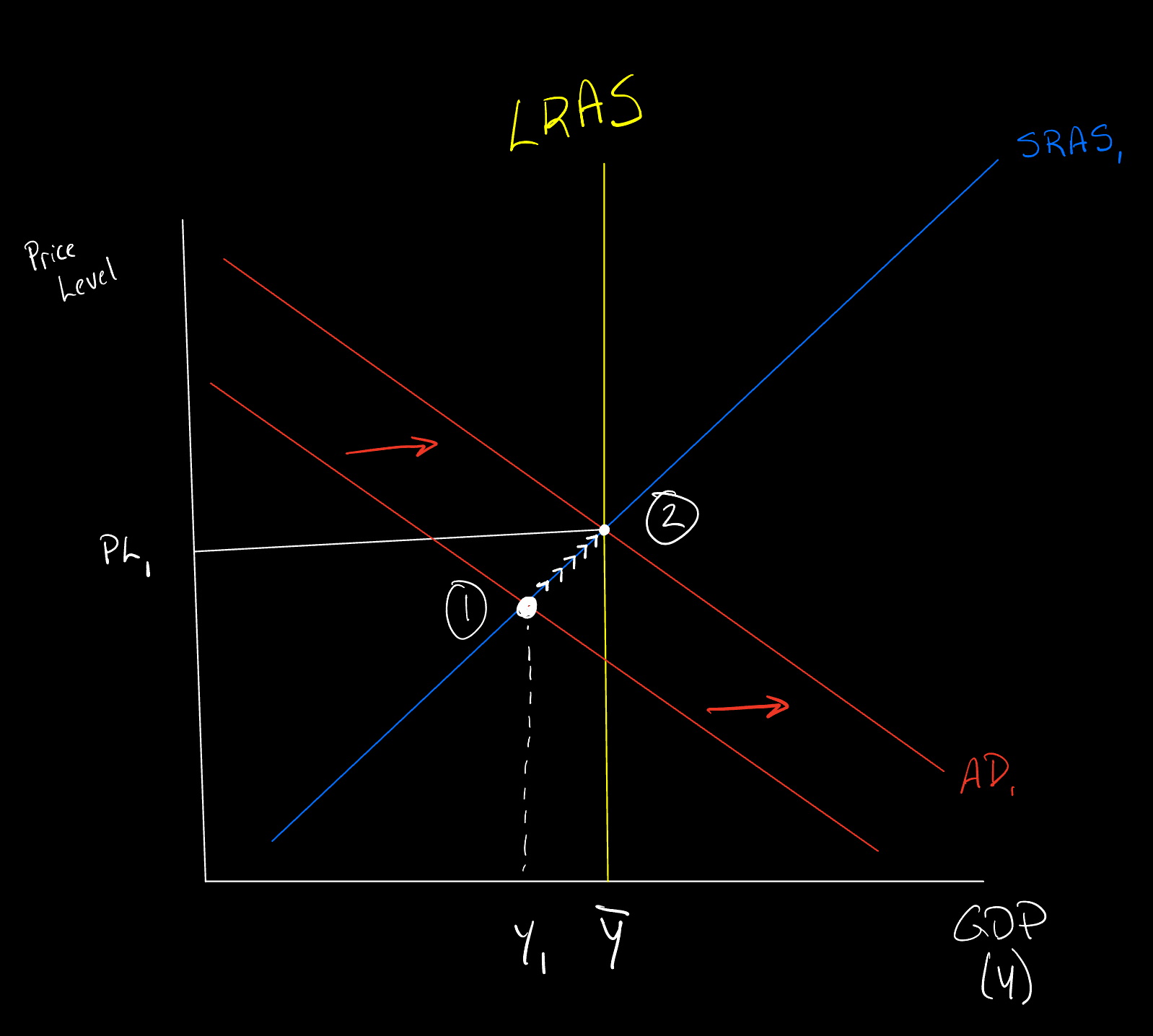
Run the reel backward for the other direction. The Fed sells bonds, the money supply shrinks, the rate rises, households park money instead of spending it, the contractor walks away from the excavator, and AD shifts left. Contractionary policy.
Now look hard at Figure 2, because this is the part that gets waved past. When AD shifts right along an upward-sloping supply curve, you get more output and a higher price level. The output is the point of the exercise. The higher prices come along whether you wanted them or not.
Stretch the horizon and it gets sharper. Short-run supply slopes up because input prices, wages included, are locked in by contracts. Contracts expire. When they are renegotiated at the new, higher price level, short-run supply shifts back, and the economy settles at roughly the output it started from, now with permanently higher prices. In the short run, cheap money buys output. Given enough time, it buys prices. Readers who sat through the inflation post will recognize the wage-lag mechanism doing its work here.
The dual mandate, and why it fights itself
Congress handed the Fed two headline jobs: keep prices stable and keep employment high. (The Federal Reserve Act actually lists three, tacking on moderate long-term interest rates, but the first two are what everyone means by “the dual mandate.”)
Both are perfectly reasonable things to want. The trouble is that the Fed has one lever, and the two jobs pull it opposite ways.
Unemployment too high? Expansionary policy. More money, lower rates, more spending, more hiring. Glance back at Figure 2 and watch the price level climb as you do it. Inflation too high? Contractionary policy. Less money, higher rates, cooler prices. But now the contractor skips the excavator, the dealer skips the hire, and the crew that would have run the machine stays home.
This is the short-run Phillips curve, after the economist who first put the pattern on paper: lower unemployment tends to arrive with higher inflation, and lower inflation with higher unemployment. The Fed is a doctor with one drug that lowers your fever and raises your blood pressure. Full dose breaks the fever and spikes the pressure. Skip it and the fever runs. There is a defensible amount to give, and it depends entirely on which one is likelier to kill you first.
Two honest qualifications, because this is a trade-off and not an iron law.
First, the goals sometimes agree. When Aggregate Demand falls on its own, in an ordinary demand-driven recession, output and prices drop together, and expansionary policy nudges both back where they belong. For a stretch the Fed gets to help everyone at once. The conflict bites when the economy is already near capacity, or when the shock comes from the supply side. An oil shock raises prices and cuts output at the same time, and no setting on the dial fixes both.
Second, the trade-off is temporary. Friedman and Phelps argued in the late 1960s that once people come to expect inflation, they bake it into wages and contracts, and the menu vanishes. You are left with the inflation and the unemployment together, which is more or less the story the 1970s told. In the long run the Phillips curve is vertical. So the Fed is not choosing between inflation and unemployment in general. It is choosing between them right now, on a menu that gets rewritten the moment people figure out what the Fed is up to.
That is the sense in which “achieve both at once” is a promise the arithmetic will not keep.
How the Fed is supposed to steer
Here is the job as drawn up on the board.
The economy slips into recession. AD has fallen left, output sits below what the economy could produce, people are out of work. The Fed sees it, buys bonds, rates fall, spending and investment recover, AD swings back right, and the downturn ends sooner and shallower than it would have.
Or the economy runs hot. AD has pushed past what the economy can sustain. Plants run extra shifts, employers bid against each other for workers, prices climb. The Fed sells bonds, rates rise, the boom cools, and inflation never gets rolling.
Smooth the cycle. Shorten the busts, shave the booms, hold the economy near its sustainable output. That is aggregate demand management, and as ideas go it is a genuinely appealing one.
Why it is harder than the board makes it look
Read that description again and notice the tense. To prevent a boom or a bust, the Fed has to move before it arrives. By the time a recession is plainly underway, the damage is already done. Which means the whole enterprise rests on forecasting, and forecasting runs headlong into three delays.
The first is the knowledge lag. What is actually happening right now? Nobody knows. GDP is hard to measure, and the BEA puts out an advance estimate about a month after a quarter closes, then revises it, then revises it again, then revises it once more in the annual reconciliation. Those revisions are not always small, and they have on occasion flipped a quarter from growth to contraction long after the fact. Averages and first drafts both hide things.
The second is the solution lag. Once you have decided what is wrong, you still have to settle on the fix. Which tool, how much? Committees deliberate, and deliberating eats months.
The third is the implementation lag. Whatever the Fed decides takes time to bite. New money has to be lent, then spent, then spent again by whoever got it. Estimates of how long monetary policy takes to work through the economy vary, but they are counted in quarters, not weeks.
Stack the three and the shape of the problem is this. You are shooting at a target you cannot see directly. A spotter tells you where he thinks it is. Your shot takes a year to land. And a while after you fire, the spotter calls back to say the target was never quite where he told you it was.
None of that means monetary policy does nothing. It means the Fed works with worse information and slower tools than the tidy diagrams let on, and that a move which would have been right in March can be doing active harm by the time it lands in December.
Where this goes next
So there is the machinery. The Fed moves the money supply, the money supply moves the interest rate, the interest rate moves consumption and investment, and those move Aggregate Demand. Push right to fight unemployment, left to fight inflation, and try not to overshoot either way while working from data that shows up late and tools that act slow.
Which leaves two questions, and they are the ones actually worth arguing about. First, incentives: does the Fed aim at the right targets? An institution run by people has to be judged by what those people are rewarded and punished for, and a central banker’s rewards are not obviously lined up with yours. Second, information: even granting perfect intentions, can anyone hit a target under these conditions, or does the attempt to smooth the cycle sometimes add a wobble of its own?
Reasonable economists disagree on both. That is a topic for another day, and the subject of part two.
How was Opus 5 weird? I've had good experiences so far but what should I look out for?