
The Self-Sufficiency Fallacy
Why not avoid ALL the taxes?

When pressed about tariff relief for businesses struggling to adapt to the new trade regime, the White House has a simple rebuttal that has been repeated by members of the Administration ad nauseum: you only pay tariffs for products that are made outside of the United States.
Problem solved! Just make everything here and the tariffs disappear. It couldn’t be simpler.
By this logic, I have even better news for Americans and, indeed, anyone in the world: you can avoid even more taxes by instead making everything in your own home. Don’t want to pay sales taxes on your shirts? Weave them yourself! Taxes on groceries too burdensome? Grow your own crops, raise your own cattle, and mill your own flour. Is the government taking too much money out of your paycheck for your liking? Quit working! As an added bonus of quitting your job, you’ll have even more time to spend enriching your life by doing even more things all for yourself instead of relying on others.
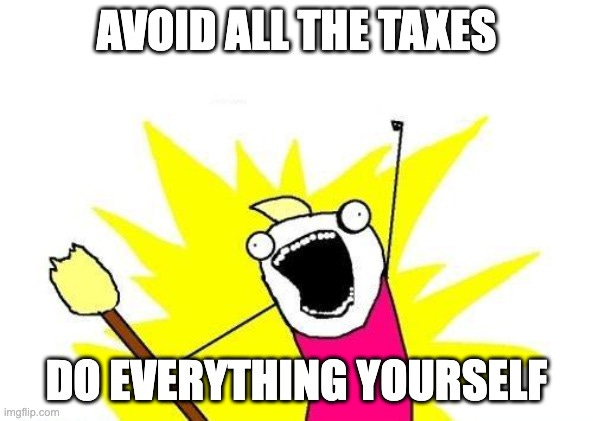
If this all sounds absurd, that’s because it is. And it’s absurd for exactly the same reasons that the White House’s “just make it here” rebuttal is absurd.
The entire point of trade, whether it be between nations or between you and the grocery store, is that specialization makes everyone better off. I don’t grow my own tomatoes, not because I can’t, but because my time is better spent doing things that I do well. The hour I would spend weeding and tending to my garden is worth more to me than the $3 or so that I would save on tomatoes. When I buy my tomatoes from a farmer who does specialize in growing them, we’re both better off.
The administration’s argument treats the tariff as if it’s the only cost of switching from imported goods to domestic production. But the truth of the matter is that imports exist precisely because domestic options were more costly in the past and have become even more costly today. If American-made goods were already less costly, nobody would be importing in the first place and tariffs would be irrelevant.
Consider what “just make it here” would actually require. It means paying American workers American wages to do work that workers elsewhere do for less. It means building factories and supply chains from scratch. It means accepting that American consumers will end up paying more because domestic production genuinely costs more. And because of those higher costs, Americans will get less. President Trump admitted as much during his “Affordability Tour,” acknowledging that our children will have to make do with fewer pencils and dolls this Christmas.
Doing those things, in isolation, sounds fantastic. But these things cannot be done in isolation just as my household cannot, in isolation, grow enough food to feed our family year-round without my wife and I quitting our jobs. In my case, that means fewer economics articles coming out, which is certainly not the end of the world. But in my wife’s case, it means quitting her job as a pediatric ophthalmologist. Given that there are only about 1,000 of them in the entire country — and 90 percent of US counties don’t have a single one — that means more children living with treatable conditions affecting their vision and brain development.
Similarly, countries cannot simply “make it here” without giving something up. Every factory we build to make goods we used to import is a factory we’re not building to make goods we’re actually good at producing. Every worker we train to assemble consumer electronics is a worker not becoming an engineer, a nurse, or a welder. The resources don’t materialize from thin air just because we’ve decided to stop trading.
Telling people they can avoid tariffs by making goods here is like telling someone they can avoid the price of lakefront property by digging their own lake. Sure, it’s technically possible, but the excavation will cost you a lot more than buying the lakefront property in the first place.
The gains from trade are real. They’re why Americans can afford smartphones, fresh produce in the winter, and clothes that don’t cost a week’s wages. Tariffs don’t eliminate those gains, they just transfer them from consumers to protected industries and make the rest of the country poorer in the process.
So yes, you can avoid tariffs by making everything domestically, just like you can avoid sales taxes by making everything at home. But you’ll be poorer for it, not richer.