
There Are No Supply Chains
The Mystery of the Mundane: An Application

Earlier this week, I posted the first “lecture” of this series, explaining Economics as “The Mystery of the Mundane.” The idea here is simple, but profound: for any thing that you can point to, there are innumerable people who must have worked together to bring that thing into existence and deliver it to you. Sure, these people are not all working exclusively toward producing a certain product (the loggers aren’t cutting down trees just for pencils, after all). But they are all still working “together” in some way, shape, or form.
This isn’t something that any one person or group of people could ever actively coordinate. And yet it happens with such regularity that, well, almost everything is considered mundane when it should probably be viewed as miraculous. It reminds me of an old (and mildly offensive) Louis C.K. clip.
But here’s the thing.
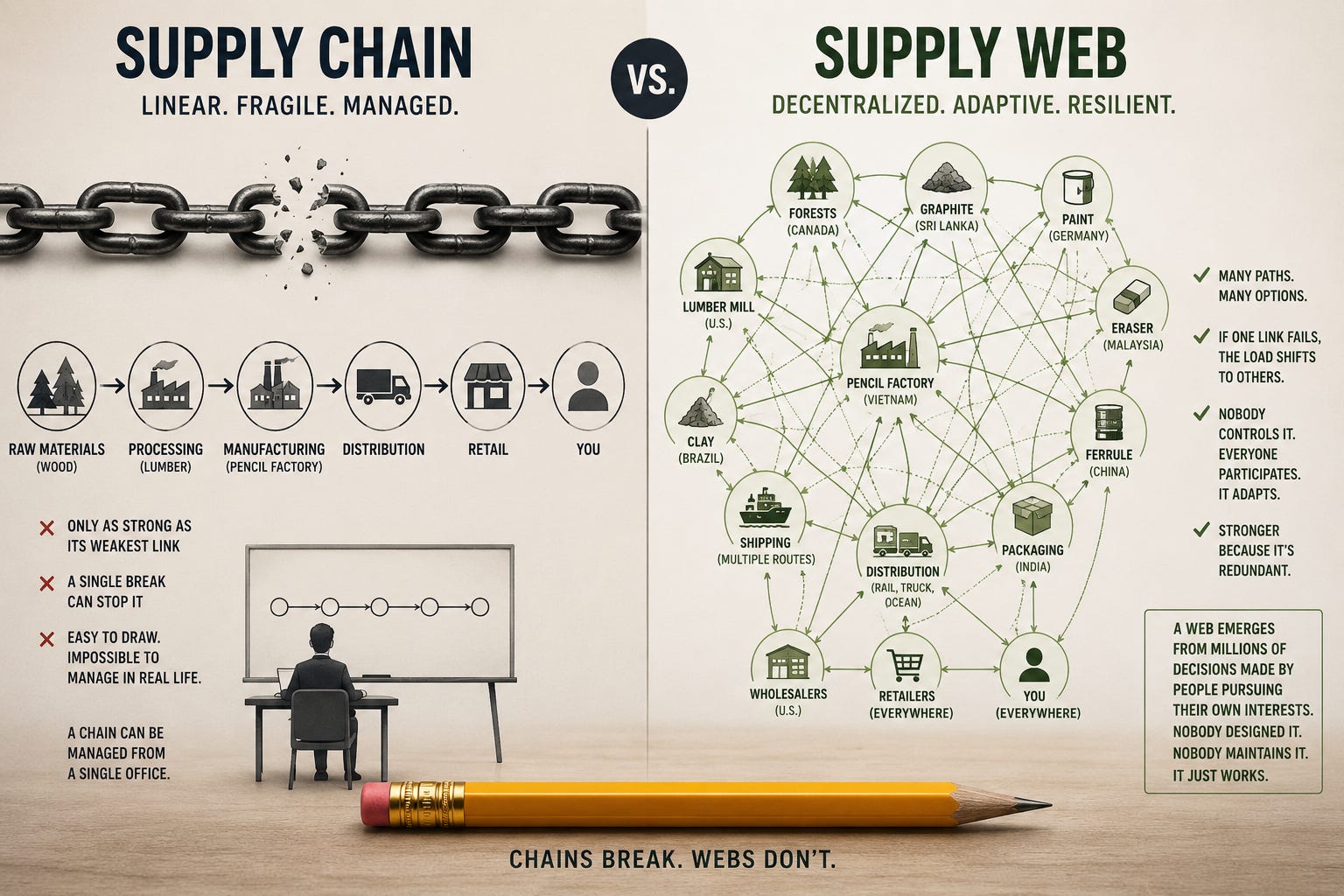
So many people think they can somehow better coordinate this incredibly complex process. They make reference to “supply chains,” as if one ill-timed break in the chain will cause disaster, or that if one country is a bad actor, they can bring down “the” economy. The truth is that there are no supply “chains.” There is an incredibly intricate supply web.
Chains Break. Webs Don’t.
A chain is only as strong as its weakest link. It’s linear, fragile, and the kind of thing a central planner could theoretically draw on a whiteboard and manage from a single office.
The web is nothing like that. When Sri Lankan graphite got expensive, manufacturers found other sources. When one railroad raised its rates, shippers found another route. Nobody coordinated those responses. Nobody had to. The web adapted because the people in it responded to the signals they were receiving — the same way it always has, for every product, in every country, without anyone in charge.
The Politician’s Mistake
Because politicians think in terms of chains, they think they can fix them. Identify the weak link, strengthen it — through a tariff here, a subsidy there, a reshoring mandate somewhere else — and the chain is more secure. It’s a tidy mental model. It’s also completely wrong.
A chain can be managed from a central office. A web cannot. The web for your pencil alone spans a dozen countries, thousands of companies, and millions of individual decisions made by people who have never heard of each other and never will. Nobody designed it. Nobody maintains it. It simply emerges, constantly and spontaneously, from people pursuing their own interests and responding to prices.
When a politician looks at that web and sees a chain to be strengthened, he isn’t just making an economic error. He’s making a categorical error — like a man who looks at a forest and sees a collection of individual trees to be individually managed. You can manage a tree. You cannot manage a forest the same way. The moment you start, you stop having a forest and start having a very expensive, very fragile, very political tree farm.
That’s what industrial policy actually delivers. Not security. Not resilience. A tree farm — dependent on continued political support, optimized for the wrong conditions, and far more brittle than the web it replaced. The supply web is redundant by nature. When one thread snaps, the load shifts to others. Industrial policy eliminates that redundancy by picking winners and concentrating production — which means that when something goes wrong, and something always goes wrong, there’s nowhere else for the load to go.
The irony is that politicians justify all of this in the name of security. But a domestic industry that survives only behind a tariff wall is itself a vulnerability — inefficient, politically dependent, and impossible to scale quickly when it actually matters. You don’t make your food supply more secure by banning grocery stores and growing your own tomatoes. You make it more secure by having more grocery stores.
The Seen and the Unseen
Bastiat warned us about this 175 years ago. Every policy has visible effects that make the evening news and invisible effects that never show up in a press release.
When a tariff lands on imported steel, the seen effect is domestic jobs preserved. Real people, real paychecks, ribbon-cuttings on cable news.
The unseen effect is everything that quietly doesn’t happen: manufacturers who shrink because input costs rose, consumers who pay more without knowing why, farmers who lose export markets when trading partners retaliate. Economists at the Fed, Columbia, and Princeton estimated that the 2018 steel and aluminum tariffs cost American consumers and businesses billions annually — borne almost entirely by us, not foreign exporters.
Worse, a domestic industry that survives only behind a tariff wall is itself a vulnerability — inefficient, politically dependent, and difficult to scale when it actually matters. Protectionism doesn’t strengthen national defense capability. It hinders it.
The ribbon-cutting gets covered. None of the rest does. And politicians understand this math perfectly, which is why bad trade policy always outlives the economists who debunk it.
Remember the Pencil
Not a single person on earth knows how to make a pencil. And yet one appears on your desk for a quarter, assembled by strangers across a dozen countries who have never met and may actively despise each other.
The web did that. Without a press conference. Without a subsidy. Without anyone in charge.
What makes anyone think they can do better?
This is perfectly relevant to the debate in Covid times, where supply problems in the international web developed and some people thought that meant controlling supply chains by requiring them to all be on-shored was an obviously better approach.
I hope you'll think about writing a subsequent piece discussing that.